| Saint Mary, Mother of God | |
|---|---|
 |
|
| Birth | 1st century BC. Nazareth, Galilee, Judea, Roman Empire |
| Feast Day | |
| Patron | Mothers, Women, Nuns, Travelers, Blood Donors, The Sick, Construction Workers, Cooks, Those Making Clothes/Jewelry |
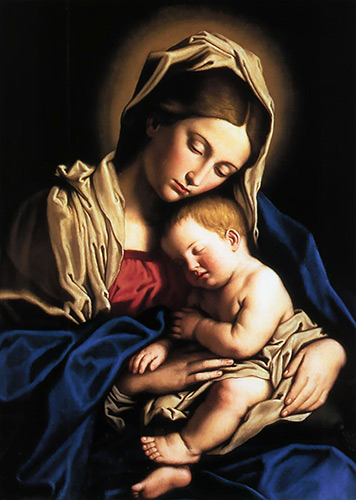
Mary is the Mother of God because she is the Mother of Jesus, true God and true Man. Because of this, she more than anyone else can lead us to her Son, for no other like her knows who Jesus is, and no one knows how to relate with Him as well as she does. Mary is the Mother who, on hearing the shepherd’s words, understood immediately that the Child was not just “her Son”. “My mother and my brothers are those who hear the word of God and put it into practice” Jesus would say one day (Lk. 8:19-21).
Personal Life
"The shepherds went in haste to Bethlehem and found Mary and Joseph, and the infant lying in the manger. When they saw this, they made known the message that had been told them about this child. All who heard it were amazed by what had been told them by the shepherds. And Mary kept all these things, reflecting on them in her heart. Then the shepherds returned, glorifying and praising God for all they had heard and seen, just as it had been told to them. When eight days were completed for his circumcision, he was named Jesus, the name given him by the angel before he was conceived in the womb" (Lk. 2:16-21).
As we think of the shepherds going in haste toward the stable, we can recall Mary’s “haste” (Lk. 1:39) to reach her cousin Elizabeth after the angel’s annunciation, and her exultant canticle, the Magnificat. The shepherds too, were “amazed” and they “returned, glorifying and praising God for all they had heard and seen” (Lk. 2:20). We could almost say that the shepherds became angels, bearing to others the glad tidings they themselves had received, since they cannot keep it to themselves.
She, who for nine months had borne Him in her womb, knew how to listen to everyone the Lord allowed her to meet: the shepherds, the magi, Simeon and Anna…because each of them would “reveal” something about Jesus’ identity and mission. [1]
"Standing by the cross of Jesus were his mother and his mother’s sister, Mary the wife of Clopas, and Mary of Magdala. When Jesus saw his mother and the disciple there whom he loved, he said to his mother, “Woman, behold, your son.” Then he said to the disciple, “Behold, your mother.” And from that hour the disciple took her into his home." (Jn. 19:25-27).
Mary “stands” under the cross. “Stands” – this indicates presence, continuity, the strength of being there. Unlike the disciples, Mary never left her Son Jesus along the way of the Cross. It is here that Jesus entrusted the “disciple whom he loved” to His Mother (and vice versa). Mary faced this moment with great dignity. She did not take flight in the face of life’s events, but remained “standing”.
Mary was invited by her Son to say “let it be done to me” once again. It is a new, a more convinced and mature “yes”. Her “standing by the cross” matures her experience of faith and of motherhood, making her capable of going beyond. From the beginning, Mary’s heart had been riddled with questions: “she pondered what sort of greeting this could be” (Lk. 1:29). Even in front of Simeon questions arose: “this child is destined for the fall and rise of many in Israel, and to be a sign that will be contradicted (and you yourself a sword will pierce) so that the thoughts of many hearts may be revealed” (Lk. 2:34-35). Mary and Joseph “were amazed at what was said about him” (Lk. 2:33). Mary did not say, “let it be done to me” once and for all. Her consent grew, it matured through what happened in her life, including her Son’s “Cross”, by which she “stood”. It is here, in this fidelity Mary achieved, that she received her new mission, a sort of “supplement” to her motherhood that culminated in her becoming “Mother of the Church”. She is Mother because she regenerates us in grace, provided that we learn to grow to “the full stature of Christ” (see Eph. 4:7-13). [2]
In the Apostles’ Creed, we profess our faith in the “Resurrection of the body” and in “life everlasting”. This is the ultimate goal and meaning of our life’s journey. This promise of faith is already accomplished in Mary, who is the “sign of sure hope and comfort” (Preface). It is a privilege granted to Mary, and closely connected to her being the Mother of Jesus. Since death and the corruption of the human body are consequences of sin, it was not right that the Virgin Mary – who is free from sin – should be affected by this natural law. Hence the mystery of her “Dormition” or “Assumption into heaven”. [3]
Miracles and Testimonies
- In Brazil - The "apparition" of Our Lady of Aparecida isn't a traditional vision but the miraculous discovery of a broken statue in Brazil's Paraíba River in 1717 by three fishermen (Domingos Garcia, João Alves, Filipe Pedroso) who, after finding the headless Virgin Mary statue and then its head, experienced an extraordinary catch of fish, leading to her veneration as the Patroness of Brazil, with her feast day on October 12th.
- In Portugal - In 1917, Our Lady appeared to three shepherd children in Fatima, Portugal. They were Lucia Santos, Blessed Jacinta Marto and Blessed Francisco Marto. Our Lady appeared to the children seven times and performed a miracle making the sun dance in the sky, which thousands of people witnessed.
- In France - The Apparition of Our Lady of Lourdes refers to 18 visions experienced by St. Bernadette Soubirous in a grotto in Lourdes, France, between February 11 and July 16, 1858, where the Virgin Mary appeared, revealing herself as the "Immaculate Conception" and calling for prayer, penance, and the building of a chapel, leading to the famous healing waters and becoming a major Catholic pilgrimage site.
- In Mexico - The apparition of Our Lady of Guadalupe occurred in December 1531 in Mexico, when the Virgin Mary appeared to an Aztec convert, St. Juan Diego, on Tepeyac Hill, asking him to request a shrine be built in her honor. The bishop demanded proof, leading to the famous miracle: Our Lady miraculously provided roses on the barren hill, and when Juan Diego opened his cloak (tilma) before the bishop, the image of the Virgin Mary appeared imprinted on the cloth, leading to mass conversions and making her the patron saint of Mexico.
Devotion
Pope Leo described Mary as a symbol of hope, which ties into the theme of this Jubilee Year—Pilgrims of hope.
He stressed that pilgrims need a goal to guide their journey, “a beautiful and attractive goal that guides their steps and revives them when they are tired, that always rekindles in their heart a desire and hope.”
The goal of this journey of life, the Pope reminded, is God and the human heart is drawn to the beauty of God.
Just as it is a mystery that Jesus became man, died, and rose again, the Pope reflected on the mystery of Mary as the mother of the Son of God. “It concerns a unique mystery of love, and thus of freedom.” Both Jesus and Mary, he recalled, said yes to their call in life. Mary’s entire life was a pilgrimage of hope with her son from birth to the heavenly homeland.It is for this reason, Pope Leo said, when we face difficult times “as individuals, families and communities…let us lift our gaze, let us look at her, our Mother, and we will rediscover the hope that does not disappoint.” [4]
Legacy
Today, the Virgin Mary, with her Magnificat, teaches us how to praise and glorify God. It is an invitation through which the Virgin Mary, today contemplated in glory, invites us to go beyond our usual mode of magnifying problems and difficulties. Mary is able, and today she teaches this to us, to look on life through another lens: our hearts are greater than our sins. And even if our hearts condemn us, God is greater than our hearts! (cf. 1 Jn 3:20) This is not, therefore, illusory, as if to say there are no problems in life. It is about appreciating what is beautiful and good in life and knowing how to thank God for it! This way, even problems are seen in their proper light.
Mary already experiences God’s glory. She has reached the goal where we will one day all find ourselves. This is why Mary is today a sign of consolation and hope because if she, a creature like ourselves, is already there, we can also join her there. Let us fix our gaze and our hearts on her who never abandoned her Son Jesus and who today enjoys the joy and glory of Heaven. And let us entrust ourselves to her so that she might help us journey the paths of life knowing how to recognize the great things that God accomplishes in us and around us. [3]
Prayer
There are many prayers in honor of Mary, Mother of Jesus, among them:
- Hail Mary
- Act of Consecration to Mary
- Maria, Take The Lead!
- Hail Holy Queen
- Vatican News - Solemnity of Mary, the Holy Mother of God (01 January)
- Vatican News - Memorial of the Blessed Virgin Mary, Mother of the Church (25 May)
- Vatican News - Solemnity of the Assumption of the Blessed Virgin Mary (15 August)
- Vatican News - Pope at Angelus: Mary is an icon of hope (15 August 2025)